Dependency What is Injection?
The most effective method used in software development today. one of the patterns is Dependency Injection (DI), that is, dependency injection, It plays a very important role especially in modern frameworks such as .NET Core MVC plays. So, what exactly is Dependency Injection and why is it so important?
Dependency Injection, externally injects the dependencies a class needs. It is a design pattern that allows This means that dependencies are inside the class. It ensures that it is managed externally rather than externally. Thus, it is more flexible, testable and It becomes possible to write maintainable codes.

Dependency Key Benefits of Injection
- Increases Code Flexibility
Thanks to DI, classes become independent from each other. This is a class When you change it, it prevents other classes from being affected. - Testability
DI makes running your tests easier because it allows you to import dependencies. allows you to write. For example, mock external dependencies with objects you can change it. - Less Dependency
DI makes classes less dependent on each other. This is simpler and easy to maintain code creates the structure

.NET Core How Does Dependency Injection Work in MVC?
.NET Core MVC supports Dependency Injection built-in. Well dependencies using DI, without adding any external libraries you can manage. Now, how to use DI in .NET Core MVC Let's examine it step by step.
Our addiction
Let's define
First of all Let's go through an example. Let's say we need an IEmailService class var:

This interface defines the basic method that will send an e-mail. Now let's create a class that implements this interface:

< p> Dependency Injection Configuration
Now, DI this EmailService class to .NET Core MVC Let's add with . For this we go to the Startup.cs file and We register our service in the ConfigureServicesmethod:

This line connects the IEmailService interface with the EmailService class. relates. The AddTransientmethod creates a new dependency each time a dependency is requested. Allows the creation of an example. Another option here is AddSingleton and It can be AddScoped, but AddTransient creates a new instance each time.
Injection of Dependency < /o:p>
Now, transfer the EmailService we provided with DI to a controller. Let's inject. Let's go to HomeController:

< br>
As you see here, constructor injection We injected IEmailService into the controller using Now HomeController Since the class depends on EmailService, the dependency is injected from outside.
Dependency Strengthen Your Software with Injection
As in the example above, DI in .NET Core MVC Using it, managing dependencies between classes becomes very easy. Thus:
Make your code more flexible You can bring it. Each class takes only the dependencies it needs, making classes more makes it independent and flexible.
- Make writing tests easier You can bring it. Thanks to DI, tests using mock objects instead of real services you can write.
- Easier to maintain software you can create When you change a class, it prevents other classes from being affected. This, makes maintenance processes much more efficient.
With DI Database Dependency
Another common usage scenario is vdatabase links. Let's say creating an IDatabaseServiceservice we want:
< o:p>

This service Let's save it again with DI:
< o:p>
 < o:p>
And Let's connect to the database using this in the controller:
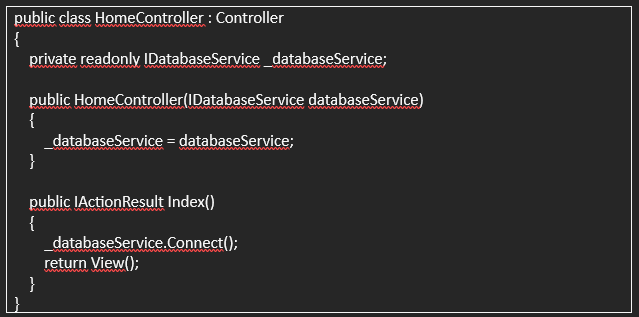
Here DI makes managing the database connection much easier. makes it easy. Managing the database service externally, especially testing provides a great advantage.
Dependency Injection in .NET Core MVC applications
The most effective ways to manage dependencies and harden your software
is one. Both flexibility, and testability, as well aseasy
provides maintenance. Make your software more maintainable, more efficient using DI
and you can make it more manageable.